




The initial noise is a free choice at test time. SDN chooses it.
Diffusion-based VLA policies generalize well, but spurious visual reliance and stochastic sampling still cause grounding failures and jerky motion at deployment. Fine-tuning a multi-billion-parameter policy for each variation is costly and risks forgetting.
Selected Diffusion Noise (SDN) is training-free: it samples several action chunks, keeps those grounded in task-relevant objects (via a counterfactual negative set), and executes the one with the lowest JerkRMS. On π0, GR00T N1.5 and N1.6, SDN adds 5 to 9 points on SIMPLER and 18.33 points on real ALOHA tasks, with no parameter updates.
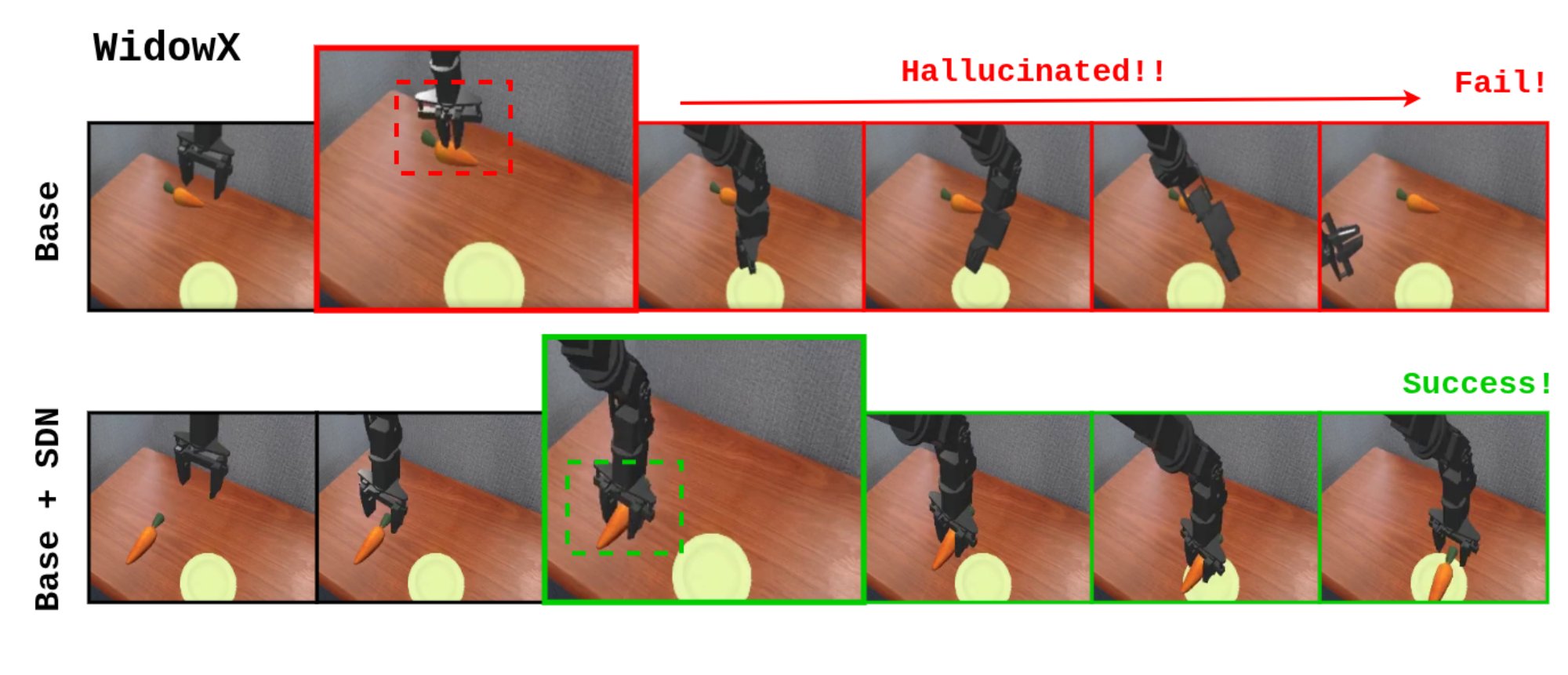
Two ways a frozen VLA fails at deployment
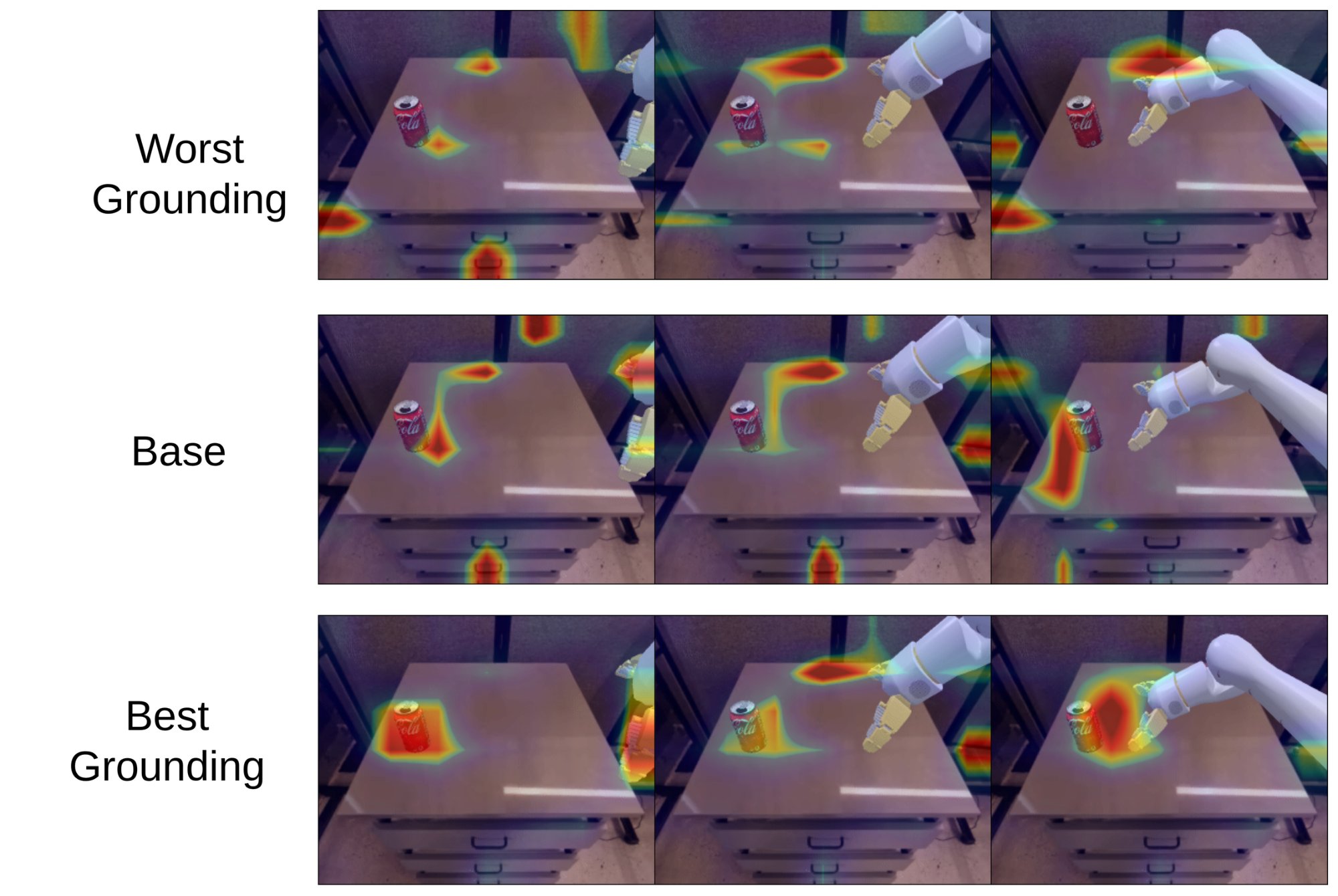
The policy follows irrelevant cues, e.g. “grasps” the carrot and carries nothing to the plate.
A correct chunk can still oscillate, destabilizing execution and wearing the hardware.
Both failures have real probability under the same input; the initial noise decides.
pfail holds the wrong or unstable chunks, with context-dependent weight ε. They are not random outliers, so the question is which sample to execute.
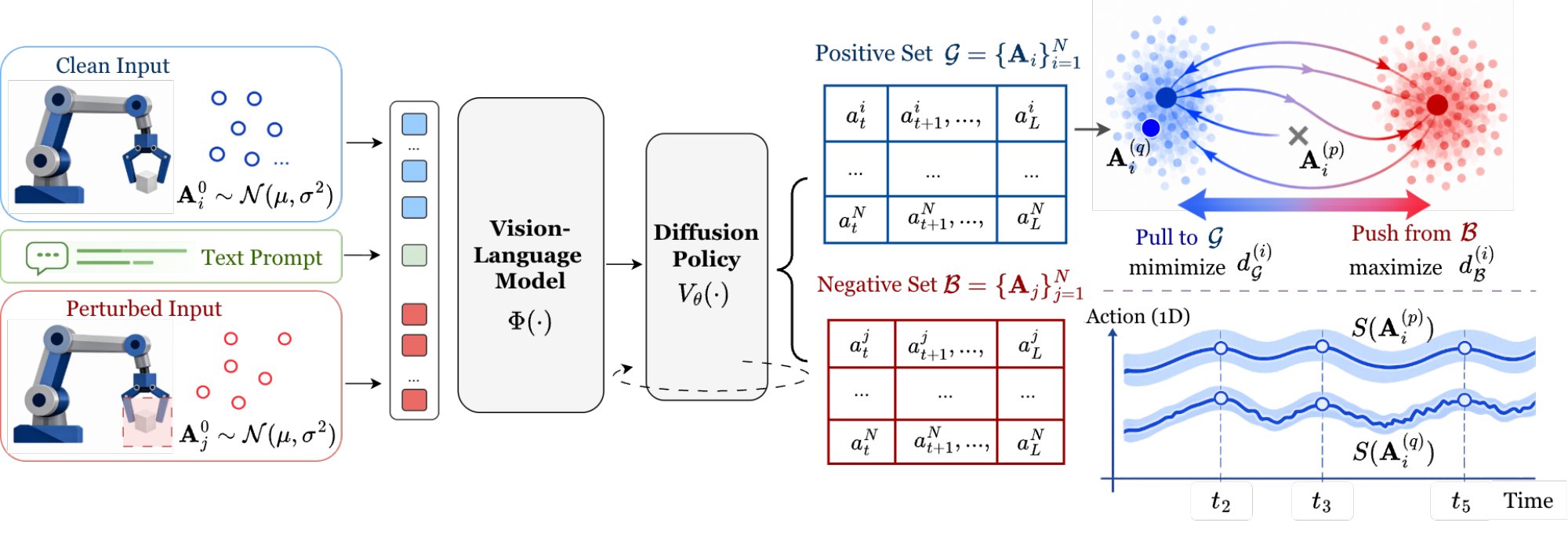
Sample N chunks, keep the grounded ones, execute the smoothest
Guidance methods like CFG steer every denoising step and need a tuned scale. SDN leaves denoising untouched: it samples chunks from different noises and picks one. Try it on a toy action space.
Synthetic points stand in for action chunks; the scores are the paper's equations. The paper uses Grounding-DINO + SAM2 masks, N = 12, k ∈ {6, 10}, M ∈ {3, 5}.
Close to the clean samples, far from the counterfactual ones
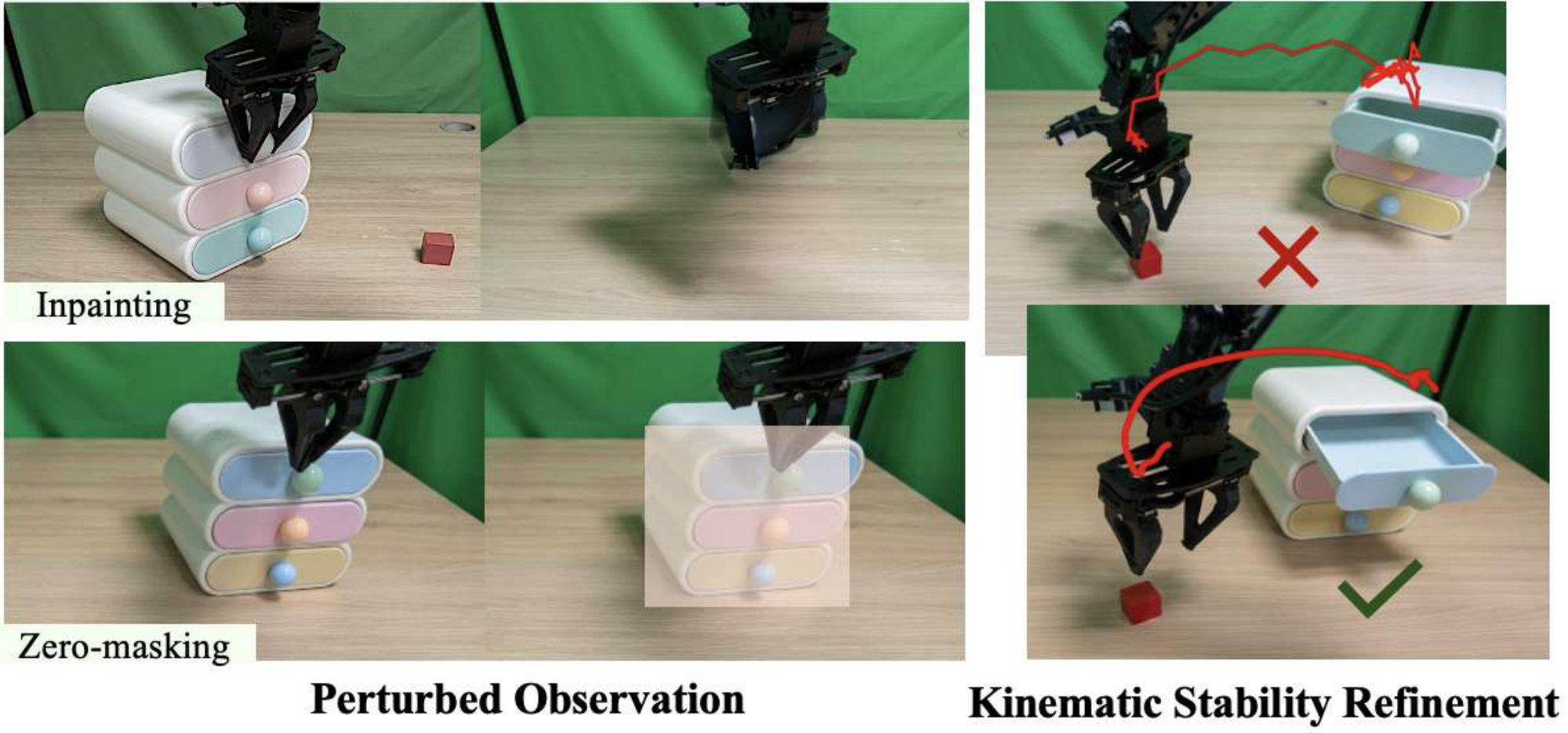
The negative set comes from the same policy with the task objects masked or inpainted away, so it can only follow spurious cues. SDN ranks candidates by how much likelier they are under pG than pB, using k-NN distances:
If no target is detected, the score falls back to −dG.
Among grounded chunks, the one with the least jerk
The top-M are scored by RMS jerk over the full predicted chunk, so late oscillations still count.
- for i = 1 … N: Ai0 ~ N(0, I), Ai ~ πθ(·|o, ℓ) into G
- if target object is detected then
- for i = 1 … N: Ãi ~ πθ(·|oneg, ℓ) into B
- Rground = dB − dG for every Ai ∈ G
- GM ← TopM(G) ▷ Stage 1
- A* ← argmin S(Ai) ▷ Stage 2
- else
- A* ← argmin dG ▷ positive grounding only
- return A*
The score ranks like the true density ratio
Since log pS ≈ −log dS + C, the distance difference is a monotone surrogate of the log density ratio. For k, N → ∞ with k/N → 0:
so the ranking is asymptotically consistent with pB−1/D − pG−1/D.
Nine tasks, two robots, two backbones
Five Google Robot and four WidowX SIMPLER tasks (as in PCD), 50 rollouts each, official checkpoints. Training-free baselines: CFG, WNG, BYOVLA, ACG, PCD. SDN uses bbox zero-masking.
Full table: all methods (underlined = best in column; subscript = SDN minus vanilla)
SDN has the best average on both backbones (72.6 with π0, 54.5 with GR00T N1.6) and never drops below vanilla on any of the 18 task–backbone pairs; every baseline does on some task.
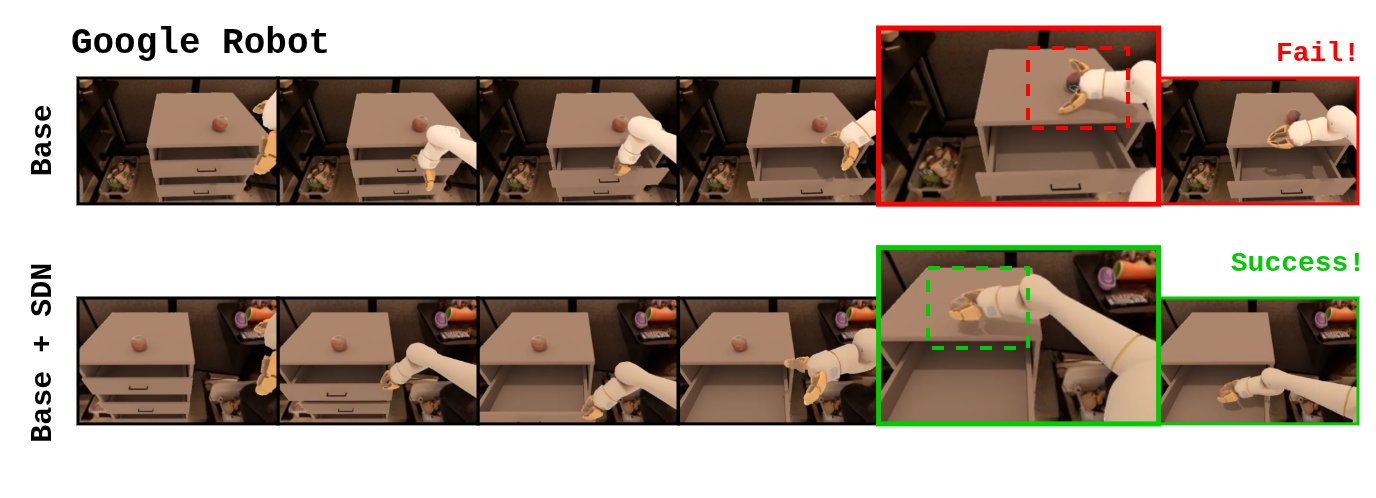
Bimanual ALOHA: higher success and smoother motion
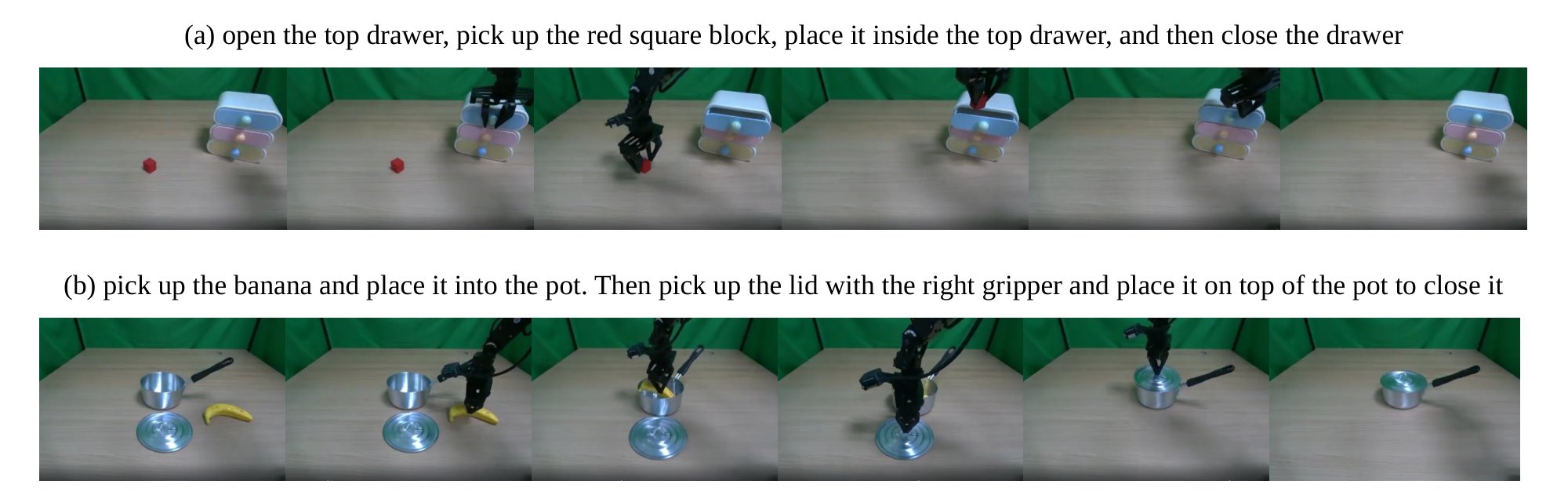
Task success
Success rate (%). Each stage helps; both together are best.
Motion quality
JerkRMS and ATV (×102), lower is better; subscripts vs vanilla.
Only SDN lowers both; every guidance baseline raises them (ACG: +114% jerk on Banana2Pot).
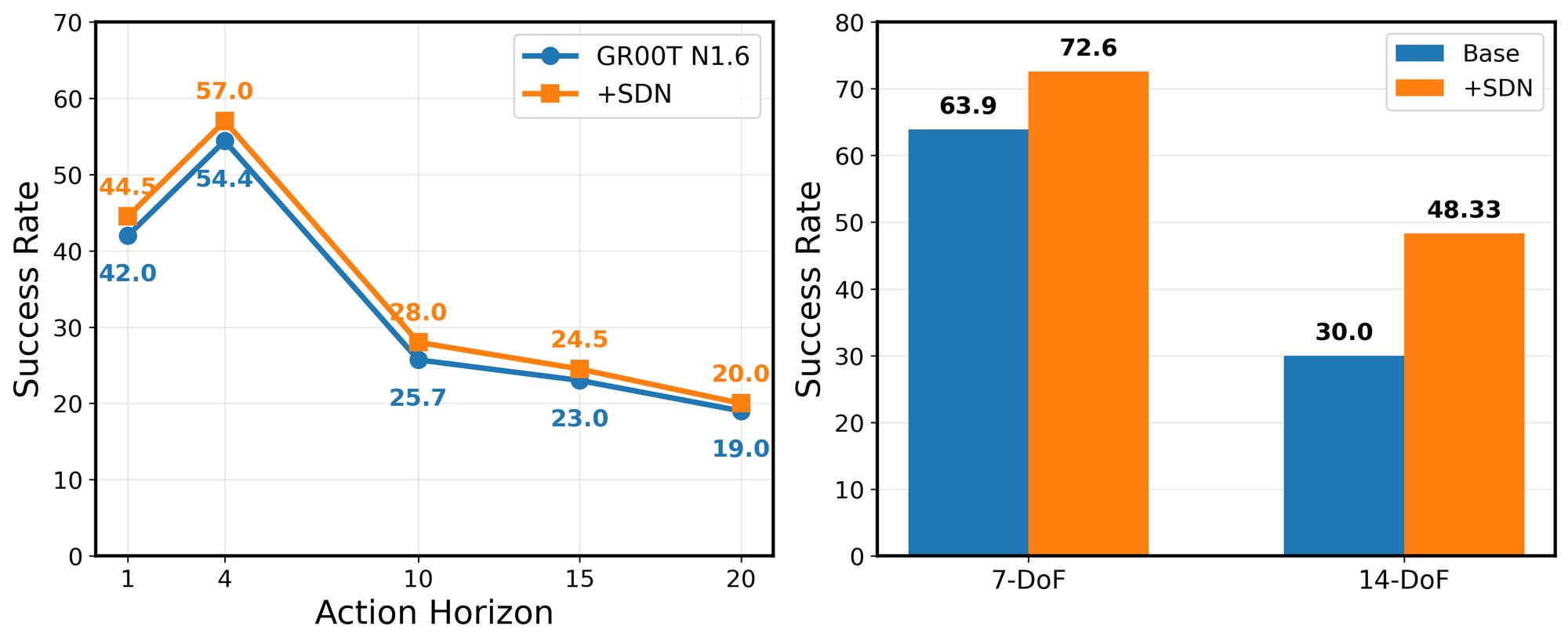
SDN reaches 48.33% vs 30.00% vanilla and 41.67% for the best baseline (Stage 2 alone +16.67, Stage 1 alone +13.33).
Why the negative set works, and what the filter selects
Masking the target collapses the policy
Success (%) with the task objects removed vs random regions masked. Without the target, the policy follows background shortcuts, which is what the negative set captures.
| Policy | Google Robot | WidowX | Avg. |
|---|---|---|---|
| π0 | 56.4 | 73.4 | 63.9 |
| + masked object | 6.0 | 0.0 | 3.0 |
| + inpainting | 5.0 | 0.0 | 2.5 |
| + random masking | 56.0 | 72.0 | 64.0 |
| GR00T N1.6 | 45.6 | 54.4 | 49.5 |
| + masked object | 2.8 | 0.0 | 1.4 |
| + inpainting | 2.0 | 0.0 | 1.0 |
| + random masking | 46.0 | 54.0 | 50.0 |
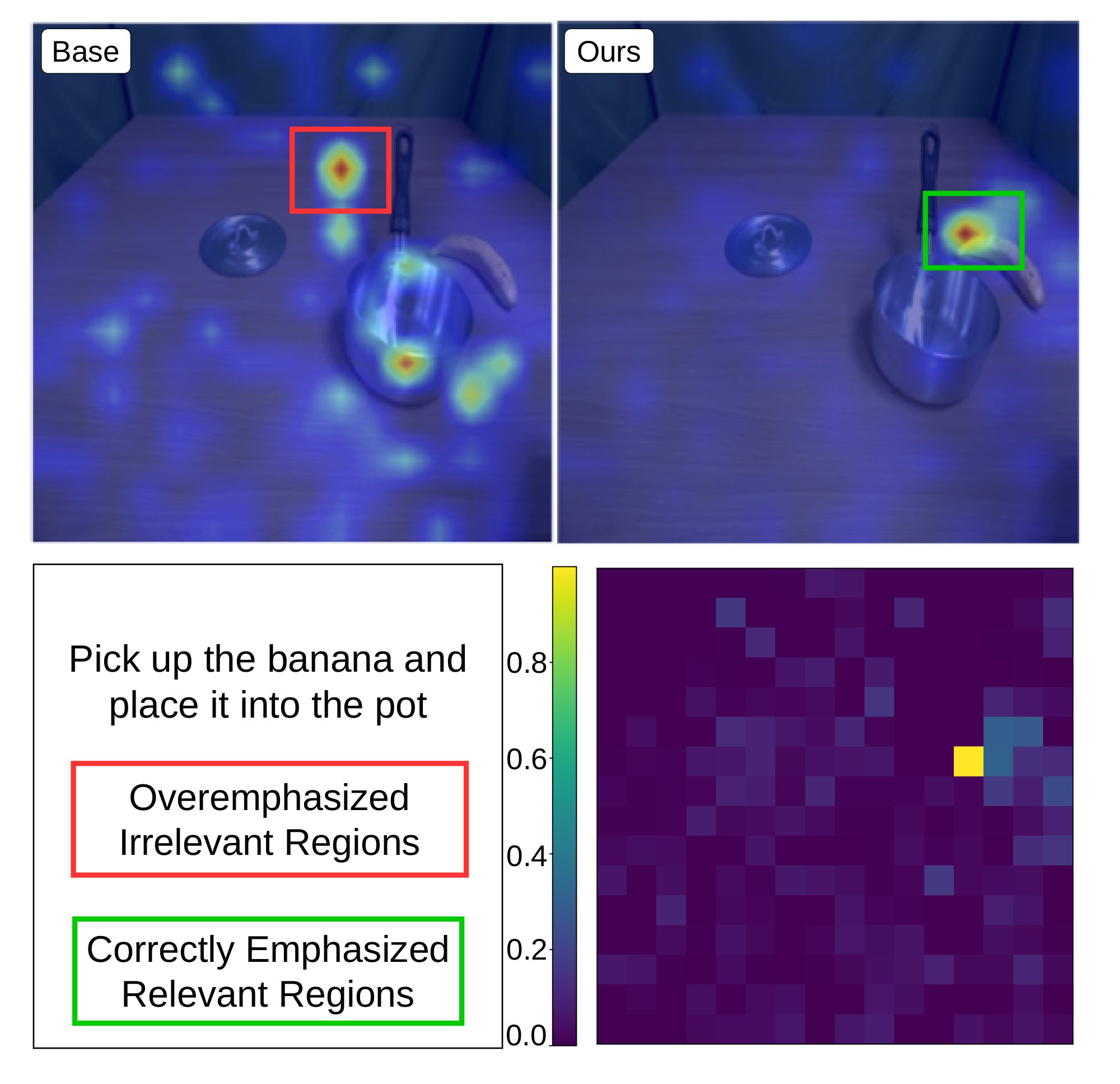
The filter picks less spurious actions
Nuisance Mass Ratio (VLA-Explain, GR00T N1.6): share of relevant tokens on irrelevant regions, lower is better. Best-grounded picks lower it; larger pools lower it more.
| Task | Worst N=12 | Base | Best N=12 | Best N=24 | Best N=36 |
|---|---|---|---|---|---|
| Pick Coke Can | 0.740 | 0.668 | 0.663 | 0.657 | 0.656 |
| Move Near | 0.780 | 0.705 | 0.679 | 0.660 | 0.667 |
| Carrot | 0.770 | 0.746 | 0.712 | 0.705 | 0.698 |
| Spoon | 0.700 | 0.684 | 0.666 | 0.661 | 0.664 |
| Average | 0.750 | 0.701 | 0.680 | 0.671 | 0.671 |
Robust to how the negative set is built
SDN vs PCD with both perturbations: SDN wins on average in all four settings, and with cheap bbox masking already beats PCD with inpainting. Underlined: better of the two.
Robust to its own hyperparameters
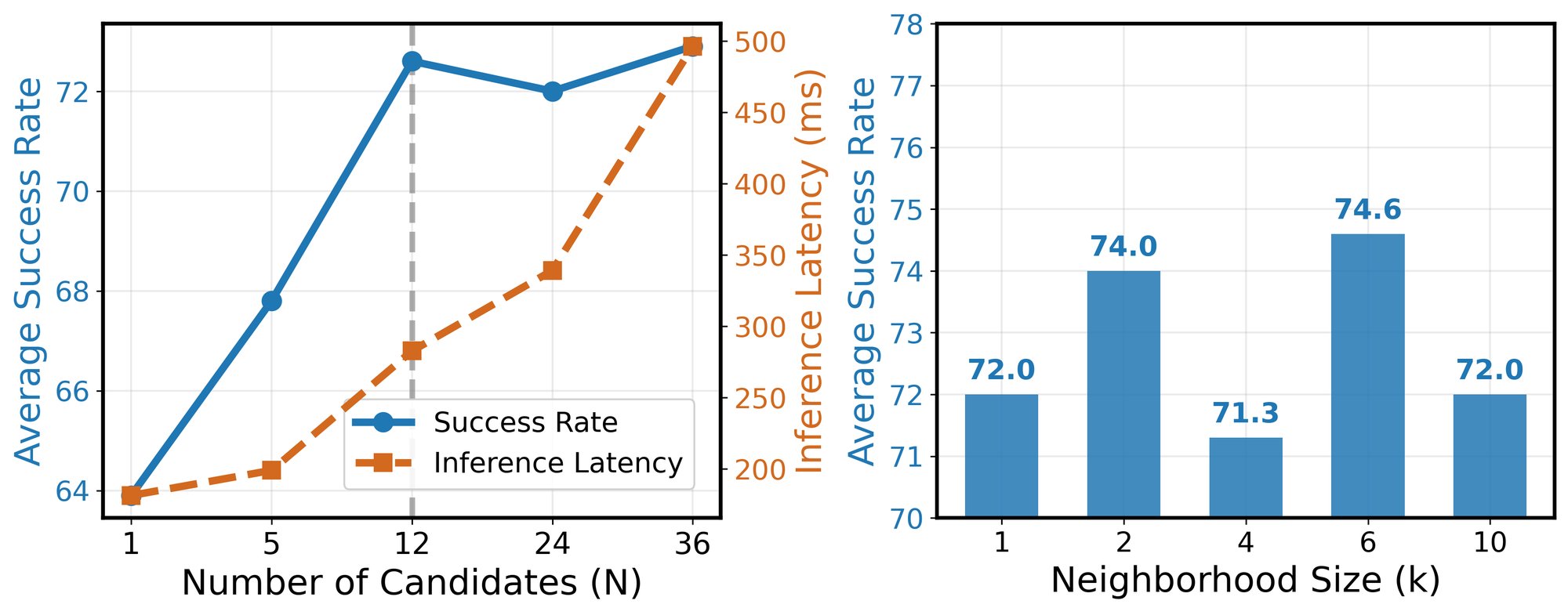
π0, SIMPLER. Success saturates at N = 12 (63.9 → 72.6); every k gives 71.3–74.6.
Across horizons and action spaces
Gains at every horizon (GR00T N1.6) and for 7-DoF and 14-DoF actions.
- Object-centric perturbations may miss spurious cues from lighting, texture or other distractors.
- N, k and M are fixed, not adapted per step.
- Extra inference compute; latency grows with N.
BibTeX
@article{nguyen2026sdn,
title = {Test-Time Improvement of VLA Policies via Selected Diffusion Noise
for Spurious-Robust Action Smoothing},
author = {Nguyen, Duc Minh and Dao, Bao-Ngoc and Luu, Tung M. and Nguyen, Binh Gia and
Tong, Vinh and Liu, Anji and Duong, Vu N. and Le, Dung D. and Sonntag, Daniel and
Le, Trung and Le, Ngan and Peters, Jan and Le, An Thai and Vu, Minh Nhat and
Niepert, Mathias and Doan, Khoa D. and Nguyen, Duy M. H. and Ngo, Vien Anh},
year = {2026}
}